Showing posts with label transplanter. Show all posts

Thursday, April 12, 2012

Dahlias

Huntin' Wabbits
Much to my chagrin, the other Whipstone interns are dropping the ball on their blog posts.  In their defenses, Dylan has made two bro-friends in the form of the new interns: Andrew and Shane - nicknames to come - and Steph is constantly getting distracted by the adorable blond babies streaking through the house.  I can't blame either of them since Our Gal Freitag has an admirable confidence with children cough*willbegreatmother*cough and Kohlrabi King loves playing music and hunting rabbits with the boys.


In any case, it is up to Super Stix to Save Our Blog.  Let's begin with Dahlias!  As they lack seeds, these beauts are one high maintenance flower.  At the end of last season, Steph, Shanti and Piedad dug up tubers from the dahlias planted in the field and separated each one.
dividing.jpg
tuber: A swollen part of a stem or root, usually modified for storage (sugar, energy, etc.), and lasting for one year only, those of the succeeding year not arising from the old ones, nor bearing a position relative to them. Examples of such perennating organs are the stem tubers of potato (Solanum tuberosum) and the root tubers of Dahlia. Root tubers develop from adventitious roots and stem tuber may be distinguished from a root tuber by the presence of buds or 'eyes'.


Dahlia cuttings rooting in foam
Cuttings-to-be in together in their box
After they are washed, the tubers are individually wrapped and stored in the walk-in cooler until ready to be planted the next year.  At the end of February, Shanti took most of the tubers and planted them in large boxes in the greenhouse to grow cuttings.  The rest were put into their own flower pots to be sold at the farmer's markets later in the year as whole plants.  The process of taking cuttings is not so cut and dry (so to speak).  When the plants start to sprout out of the buds they are cut directly above the growth-origin.  To combat last year's problem of the cuttings not sprouting roots, we are experimenting with first putting them into foam cells that are specifically made to encourage rooting.  Once the roots begin popping out of the sides and bottom of the foam, they can be transplanted to regular plant trays - put on our heated tables and will hopefully continue to expand inside of these new cells.  We began this third step on Monday and will continue to fill the trays with each of our twenty or so different varieties until they are finally ready to be transplanted to the field, hopefully in early June.  Unfortunately, we will have to wait until August to start picking these floral eye candy.  For the moment, we are blessed to have tulips, daffodils and ranunculus to fill our bedrooms - oh and to sell, of course - so I am not complaining.
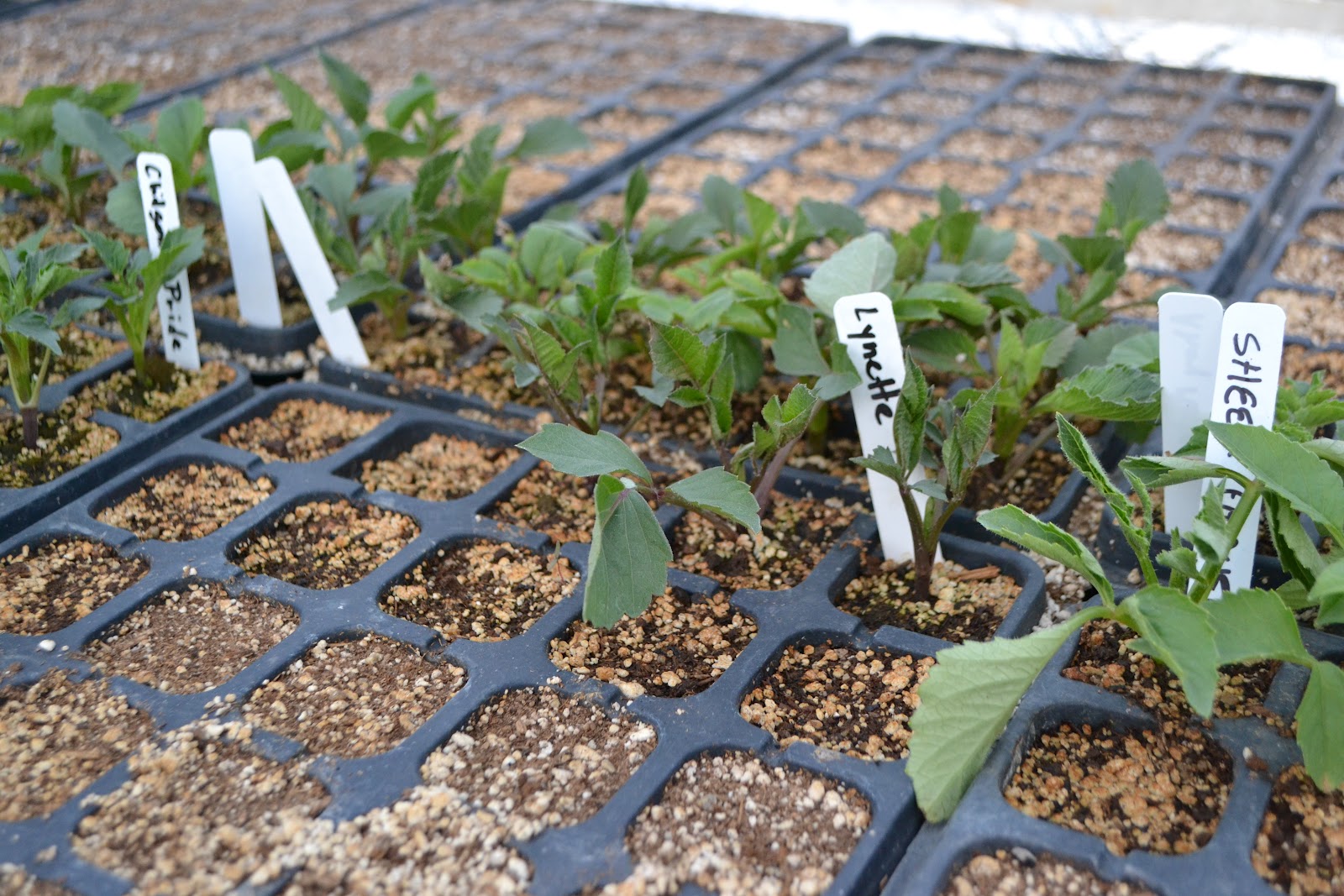
Each variety gets its own tray, no matter how many cuttings are rooted.  Different types do better than others for reasons unknown...
Back right: boxes of planted tubers
Back left: rooting cuttings
Front: in their trays and ready for transplant

Thursday, March 8, 2012

Cebollas!

Over the past few days we have transplanted about fifteen beds of onions.  These guys are quite hardy, so they are often one of the first vegetables to go into the ground and they are only planted once a season.  Some onions will be harvested as spring onions in a couple of months.  The rest will get picked in August/September, after they spend the summer growing into delicious cooking ingredients and tear generators.

Two of the onion varietals were planted by hand.  This is quite the labor-intensive process as each bed contains four rows of plants, planted about three inches apart.  Luckily, we utilized the Prescott College students that visited the farm for one of their classes yesterday and managed to finish the process relatively quick.  The rest of the planting can be done using a transplanter, which is pulled behind the tractor.
Stix ready to plant some Amaryllidaceae
Two people sit in the back of the transplanter and stick the plants into holes made by a spikey wheel.  For these onions, we did three rows per bed and there is less user error in the spacing thanks to the spikes.  This is an easier operation as there is less bending and overall body movement - you are sitting after all.  However, it takes more concentration to keep up with the tractor.

Steph cleaning mud off the spikes on the trasplanter


After throwing some pungent fertilizer on the newly planted beds, the last step of the process is to lay irrigation. At Whipstone, we use drip tape to ensure maximum watering efficiency; it virtually eliminates evaporation and is easy to use.  Rubber hoses are laid between each row (usually two per bed) and attached to a master hose that runs along the heads of the beds.  The drip tape is secured into the ground with staples for when that high desert wind picks up speed.

Planted onion beds with drip tape