Showing posts with label greenhouse. Show all posts

Thursday, April 19, 2012

Crisis on the Farm!

The water has stopped working.  Imagine the catastrophe: in addition to keeping the greenhouse and all of our planted beds watered, Steph can't even cook dinner... Not to mention the wedding that Shanti has to arrange flowers for tomorrow.
RIP Ranunc

In other news, a valued member of the Whipstone family passed in her sleep late last Saturday night.  RIP Pigeon - you will always be a puppy in our eyes; even at 12 years-old.

We also plowed under the Ranunculus in the OG (original greenhouse).

Thursday, April 12, 2012

Dahlias

Huntin' Wabbits
Much to my chagrin, the other Whipstone interns are dropping the ball on their blog posts.  In their defenses, Dylan has made two bro-friends in the form of the new interns: Andrew and Shane - nicknames to come - and Steph is constantly getting distracted by the adorable blond babies streaking through the house.  I can't blame either of them since Our Gal Freitag has an admirable confidence with children cough*willbegreatmother*cough and Kohlrabi King loves playing music and hunting rabbits with the boys.


In any case, it is up to Super Stix to Save Our Blog.  Let's begin with Dahlias!  As they lack seeds, these beauts are one high maintenance flower.  At the end of last season, Steph, Shanti and Piedad dug up tubers from the dahlias planted in the field and separated each one.
dividing.jpg
tuber: A swollen part of a stem or root, usually modified for storage (sugar, energy, etc.), and lasting for one year only, those of the succeeding year not arising from the old ones, nor bearing a position relative to them. Examples of such perennating organs are the stem tubers of potato (Solanum tuberosum) and the root tubers of Dahlia. Root tubers develop from adventitious roots and stem tuber may be distinguished from a root tuber by the presence of buds or 'eyes'.


Dahlia cuttings rooting in foam
Cuttings-to-be in together in their box
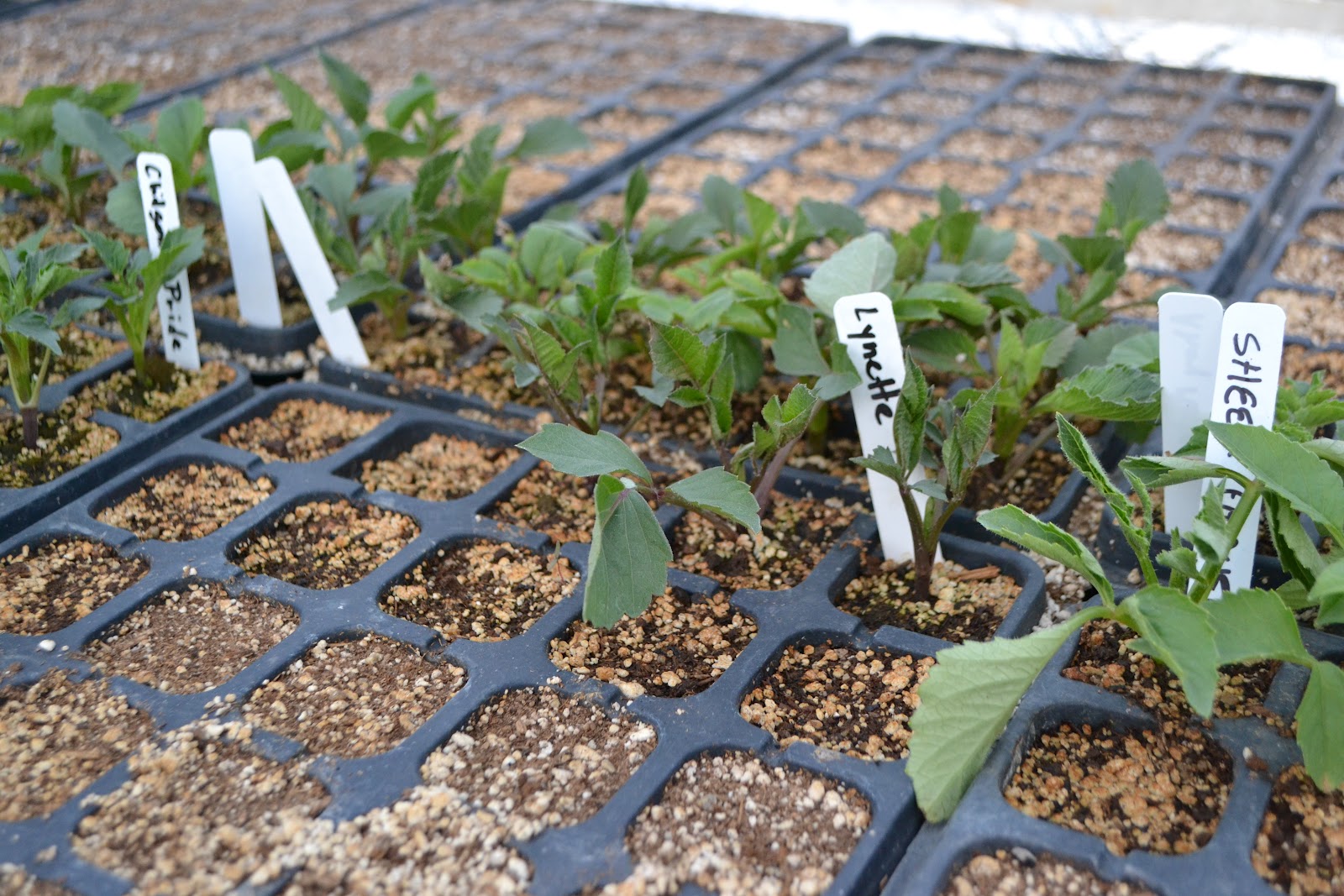
After they are washed, the tubers are individually wrapped and stored in the walk-in cooler until ready to be planted the next year.  At the end of February, Shanti took most of the tubers and planted them in large boxes in the greenhouse to grow cuttings.  The rest were put into their own flower pots to be sold at the farmer's markets later in the year as whole plants.  The process of taking cuttings is not so cut and dry (so to speak).  When the plants start to sprout out of the buds they are cut directly above the growth-origin.  To combat last year's problem of the cuttings not sprouting roots, we are experimenting with first putting them into foam cells that are specifically made to encourage rooting.  Once the roots begin popping out of the sides and bottom of the foam, they can be transplanted to regular plant trays - put on our heated tables and will hopefully continue to expand inside of these new cells.  We began this third step on Monday and will continue to fill the trays with each of our twenty or so different varieties until they are finally ready to be transplanted to the field, hopefully in early June.  Unfortunately, we will have to wait until August to start picking these floral eye candy.  For the moment, we are blessed to have tulips, daffodils and ranunculus to fill our bedrooms - oh and to sell, of course - so I am not complaining.
Each variety gets its own tray, no matter how many cuttings are rooted.  Different types do better than others for reasons unknown...
Back right: boxes of planted tubers
Back left: rooting cuttings
Front: in their trays and ready for transplant

Tuesday, March 27, 2012

Peppahs!

Well, here it is, the world premier of a Stephani Freitag blog post. Emily's weeks of nagging finally paid off. From here on out, we are attempting to make one small post daily between the three of us. Wish us luck! It's easy to get lost in the farm.

The lovely Piedad, seeding away in the greenhouse.
Whipstone takes great pride in it's pepper production, due in most part to Cory's adoration of the spicy fruit. It was almost two weeks ago now that Emily, Piedad and I had a pepper seeding extravaganza in which we began the life of over 10,000 pepper plants. Some like it hot, and peppers are no exception. Last year, we wrapped the seed trays up for extra warmth. This year, however, we were able to make good use of our new, fancy, water-heated propagation tables.


These tables have small (1/2 inch in diameter) PVC piping running underneath a big piece of sheet metal. Heated water runs throughout the pipes and circles back to be reheated and used again. The hot water in the pipes heats the sheet metal and we place the seeded trays on top of the metal. We are able to set the water to whatever temperature we desire. This allows us to heat just the water and not the entire greenhouse, saving on gas usage (score!). A project for next year is to install solar water heaters;
no more gas for the greenhouse and less greenhouse gases!

Piping that runs under the sheet metal.


Reflective, insulated tents.
To beef 'em up even more, we built tents made of a reflective insulation in which we cover the tables at night (when sunlight is no longer available). This aids in decreasing heat loss. Bottom line: perfect new beginning for a little pepper plant. Just a few short days after seeding, with a dash of sunshine and a sprinkle of water, it's cotyledon city.

DEFINED: 

cot·y·le·don

  [kot-l-eed-n]
noun Botany .

Kind of boring, I know. I can just see the image from my BIO101 textbook in my head. The little leaves that live within in the seed and pop out of the coat at germination. The idea put me to sleep when lectured in school, but is actually pretty incredible to witness in the real world. It's a beautiful thing to look down 2 30-foot tables, and see them completely filled with little bitty pepper plants.


Corny biology textbook drawing.
Cotyledons with seed coat still attached.


Peppahs!
Pepper germination looks great this year, thanks in most part to our wonderfully efficient propagation tables. I can't wait until we get them in the ground in May so I can be eating delicious fresh guerritos come August. Yum.